
Societies evolve along the same cycle of eleven stages that individuals do, because what is a society but a collection of individuals? So how can we identify what stage a society is currently experiencing? Whether it’s a town, county, state, province, country or the entirety of humanity, any group of individuals will follow a normal curve. That means, if you plot the number of people in each stage, you will get a graph that looks something like this:
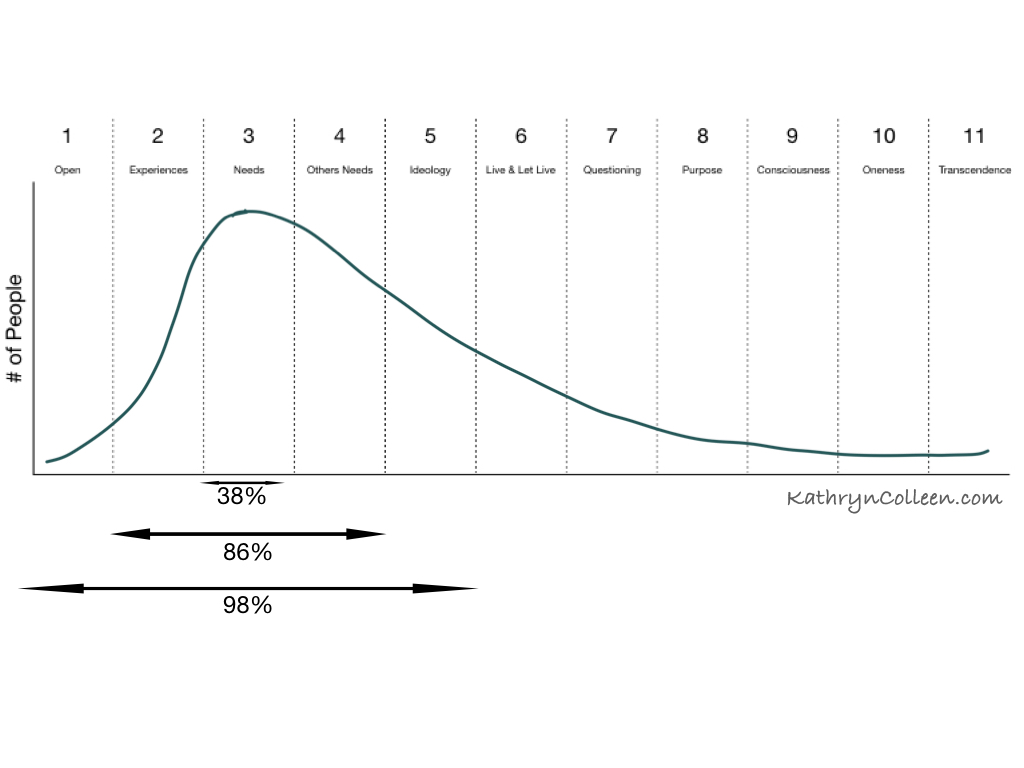
In this example, we would say this particular country is in Stage Three, because there are more people in Stage Three than in any other stage. But that doesn’t mean that EVERYONE in that country is in Stage Three. In every society, you will have some people in each stage. The beauty of the normal curve is that it gives you a pretty good estimate of what percent of the population is in each stage. So if, like this example, we have a peak in Stage Three, we can see that is is likely that 38% of the population is in Stage Three and focused on their own needs. And if we take Stages 2-4 all together, we would have about 86% of the population accounted for. That puts about 24% of the population in Stage Two and another 24% in Stage Four. This is a typical scenario for third world nations and those recovering from war or natural disaster. In these countries, is a portion of the population simply stunned by what has happened or what is currently happening (experiences), another portion just focused on survival needs, and another portion focused on helping others. The remaining 14% of the population is scattered between Stages 1, 5, and 6-11.
Let’s take a look at what that means for societies in other stages. A country in Stage Five would look something like this:
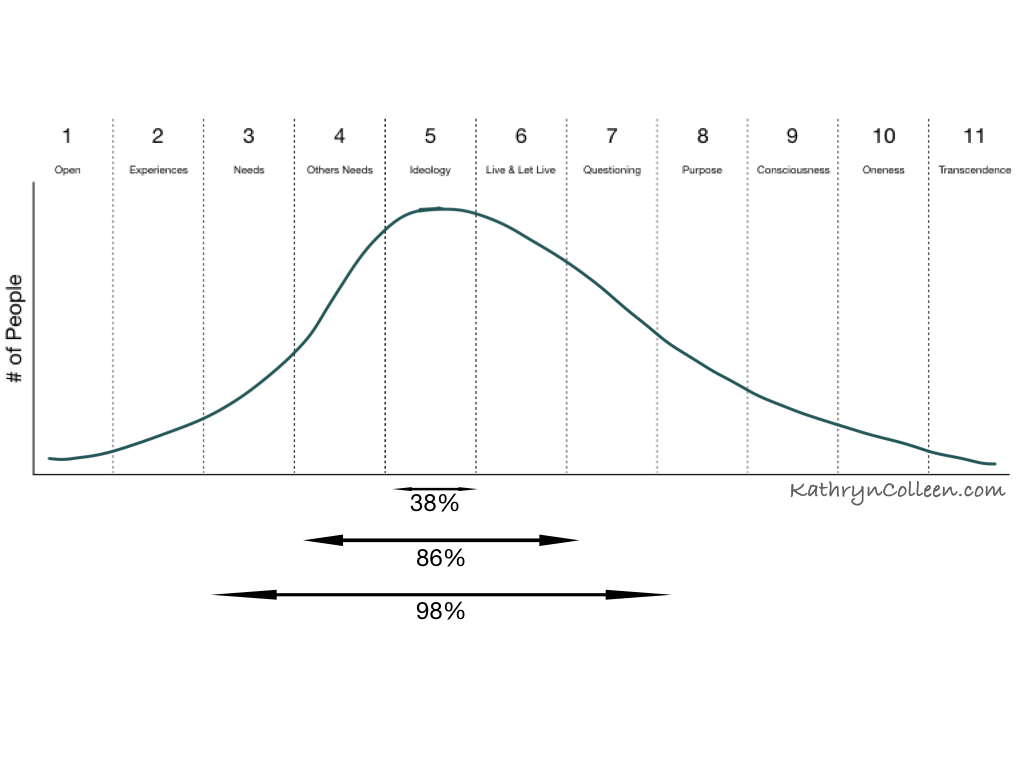
This would include most first world countries today and several developing nations with religious governments. In these societies, you again see three main portions of the population. Here you would have roughly 24% in Stage Four, largely focused on the needs of others, 38% in Stage Five, feeling offended and angry and constantly defending their ideology while berating others, and 24% in Stage Six just trying to live their lives. The remaining 14% of the population is scattered between Stages 1-3 and 7-11.
Not surprisingly, societies in Stage Five look like a real mess. Headlines will say it’s the end of the world and everyone will feel like their society is falling apart. The majority of new articles will focus on ideology (political or religious), people of one ideology bashing people of an opposing ideology, and the ensuing divisiveness. In fact, headlines may reflect the population percentages with some portion of headlines discussing good deeds done by those attending to the needs of others, people in great need, people questioning everything, and a few spiritual people talking about connection.
A Stage Six society, focused just one stage over would be quite a bit different.
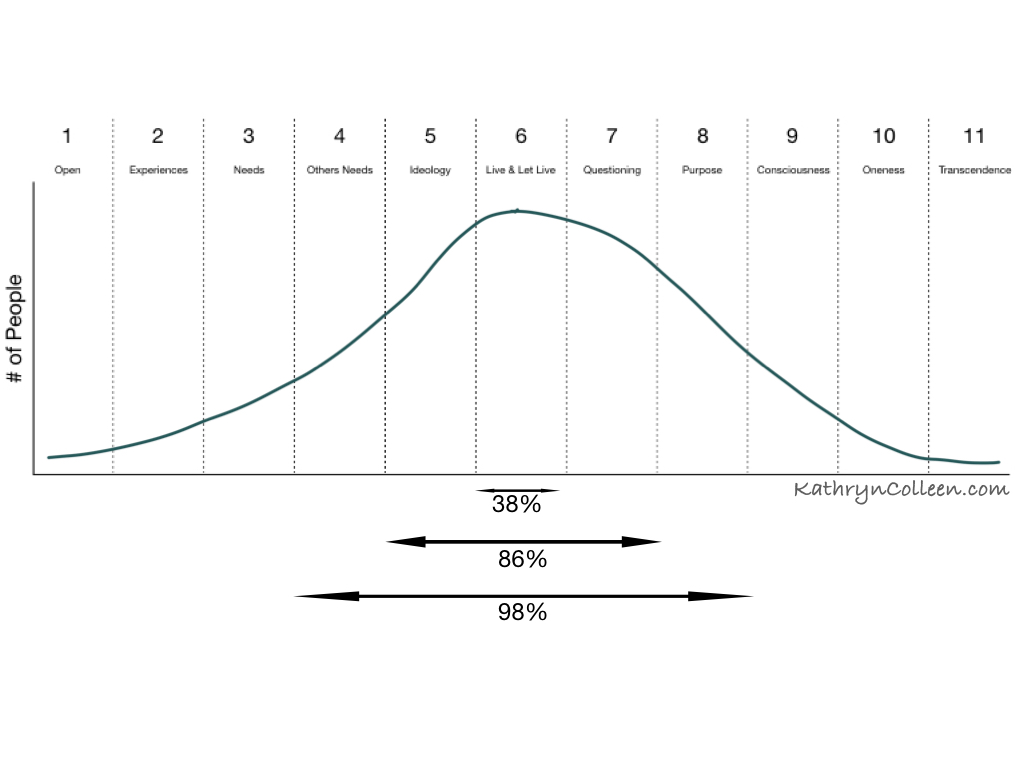
In these societies, you have a large number of people (38%) happy to just live and let live. You now have just 24% in Stage Five. This is enough to cause a lot of lashing out online, but the headlines in these countries would not tend to lead with ideological divisiveness. Although there would still be a decent portion of headlines focused on who said what about which political or religious issue, the majority of headlines would become more about actual happenings, with a portion on headlines devoted to disillusionment with status quo, innovation and new ideas. This disillusionment and innovation comes from the 24% of the population in Stage Seven.
Stage Seven is an interesting stage. The first time an individual encounters Stage Seven, it is all disillusionment; the dark night of the soul. But when we encounter this stage later on in subsequent trips through the cycle, it takes on a flavor of innovation and becomes, ultimately, a lot of fun. Some developed nations have seen Stage Seven before. It looks like revolution – political, social or cultural. In fact, that is the order you would tend to see in any given country. The first time a society encounters Stage Seven typically results in political revolution – a major shift in structure. If the new choice of structure was a bad one, you might see another political revolution later. Once a better structure is in place, subsequent trips through Stage Seven will look like next a social revolution (such as the American Civil Rights Movement), and then a series of cultural revolutions that include significant innovation.
So we can think of a number of countries that have seen Stage Seven several times. So why do they seem to be in Stage Five now? It’s a cycle. That is key. Individuals and societies alike all traverse the cycle. Elections and societal shifts can pull a population back around to Stage Five just as war can pull them back around to Stage Three.
But fear not. Each time we traverse the cycle, we do it faster, and we go farther.
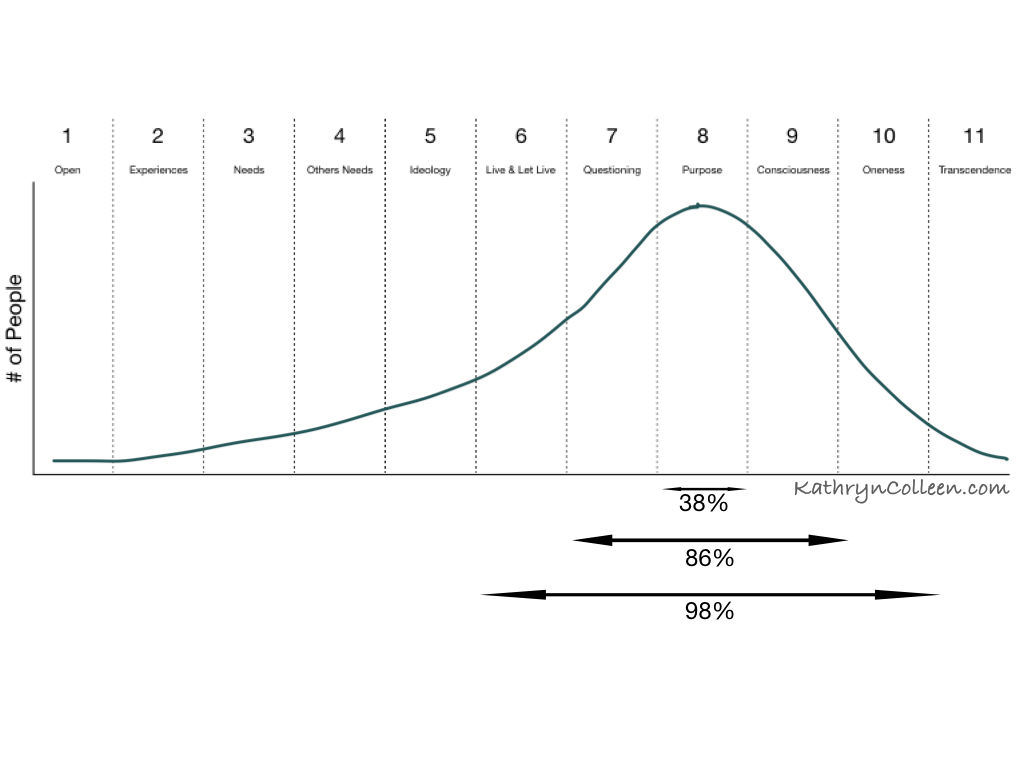
So what happens when we eventually get to a society where the peak is in Stage Eight?
The Stage Eight society is one of incredible productivity, joy, and passion. You have about 38% of the population reveling in their purpose-driven efforts; doing what they were born to do and loving it. That means they are doing it very well. The 24% of the population in Stage Seven will be largely the innovation type, rather than the disillusionment type. That only feeds purpose-driven action even further. And then there are 24% of the population in Stage Nine. This is an incredibly peaceful stage, marked by increased intuition and patience. What a great mix!
For the economists out there, that means quality products, large scale innovation, new markets and ideas and people excited to make them real. In short: massive prosperity.
For the government and law enforcement out there, this is a peaceful society. Crime is at an all time low. Altruism is at an all time high. People are nice to each other, and those few in Stage Three with unmet needs are more than attended to by the larger number of people in Stages Four and Eight. Stage Five population is now so small that any negative effect is neutralized.
And it only gets better from there.