

We know that societies, whether a town, state or an entire country, evolve through the same stages of development that individuals do – because a society is just a collection of individuals. At any one time, if you mapped out the population by stage, it would look like a normal curve that peaked at that society’s primary stage.
For example, if a society was primarily in Stage Five, it’s population would look like this.
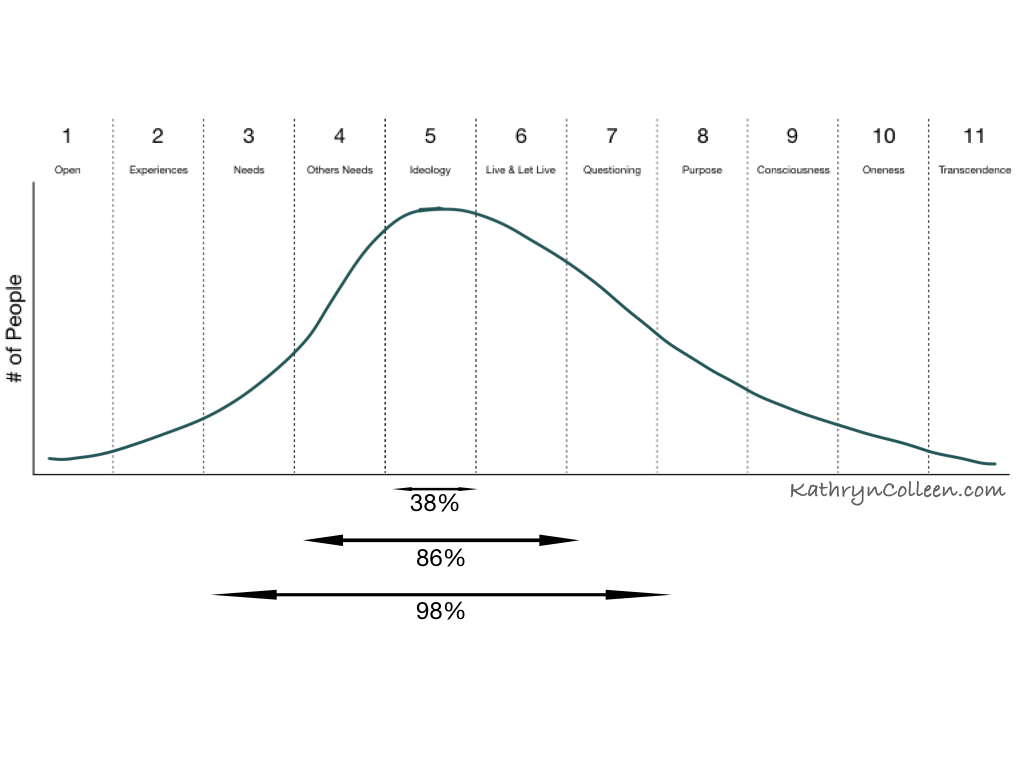
If you wanted to move that peak to another stage, I believe you could do that. But before I tell you how to do that, let’s discuss the ethics of doing something like that.
Suppose a society was in Stage Three – such as a developing nation – and you wanted to move them to Stage Six – a fully developed and peaceful nation. That’s a nice idea. Not too many people would see a problem with that. But suppose instead that you intentionally moved a society to Stage Seven (questioning everything). This would be incredibly destabilizing and irresponsible. You would have a full third of the population protesting, rebelling, and/or so depressed that they could not function. Not cool.
Essentially, if a society is in a rough stage like 2, 3, 5 or 7, you are doing them a favor to help them get past it to a more pleasant stage. But if you intentionally move a society to one of these rough stages where negative emotions dominate and problems abound, then I cannot condone that. Don’t do that.
And be aware that, you can move a society temporarily to a higher stage directly, but they won’t stay there very long. They will stay only as long as you continue to focus them there. A permanent shift to a higher stage requires stepping through each stage along the way. So if a society is in Stage Three, and you want to move them to Stage Eight, that means you will have to walk them through Stages 4-7. You will have to competently shepherd them through all of those stages, including Stages Five and Seven. And if you don’t do that correctly, they could get stuck and getting stuck makes things infinitely worse. Because getting stuck in any stage amplifies the effects of that stage, getting stuck in a stage full of negative emotions does a lot of damage and can result in criminal and otherwise dangerous personalities.
Now that I have scared you away from trying to influence an entire society, let’s talk about how to do it. There are two ways to do it: temporarily or permanently.
To temporarily shift a society to a given stage, you would, in theory, simply inundate them with the questions and signals relevant to that stage. I can imagine several ways to do that. I bet you can too. The only time this might not work is if you are trying to shift a Stage Three society too far away from Stage Three for too long. For those societies focused on the needs of survival, you will not get a major shift, or a long term shift, but you could get a shift to Stage Four for a few months. Ultimately, you will have to help them meet their needs in order to get a larger shift. For other societies in Stage Four and higher, you could exact a larger shift, for example from Stage Five (ideology) to Stage Eight (purpose) for months at a time. But it will not be sustainable, because they did not adequately address the stages between.
To move a society to a previous stage from where they are now, you will have to provide an appropriate trigger, at scale, based on the stage you want. For example, if a society is currently in Stage Five (ideology), and you want to move them to Stage Four, that is a step backwards and will require intense focus on the needs of others, which people in Stage Five do not worry too much about. You would have to take them back to Stage Three, and then move them forward to Four from there. But taking people back to Stage Three, or backwards at all, is a really mean thing to do. Don’t do that. Move them forward instead.
To move a society to another Stage with more permanent results, you will need to help them address each stage in turn along the way.
Let’s start simple. Suppose that you have a Stage Five (ideology) society and you want to move them just one step to Stage Six (live and let live). You would certainly start with a temporary move using questions and triggers. But then you will have to back it up with helping them to do the work needed to complete Stage five so that they can move on and not be pulled back. The work for Stage Five includes moving your ideology from being based on specific beliefs, issues and rules to being based on principles instead. You will then need exercises that show how our principals are largely all the same. See the various tasks listed in Stage Five of the main book, Purna Asatti. Take the homework designed for individuals there and apply that to the society at large.
So how do you get an entire society to do the homework? That’s the tough part. If you could turn it into a game, that would be ideal. It’s a lot easier to work one person at a time and spread virally from there but that takes time.
But suppose a society could benefit from just their leaders shifting stages? That would be a great opportunity to apply techniques to shift just those individual leaders into more beneficial stages. Perhaps there would be a ripple effect through the society.
But here’s the thing… societies are just a collection of individuals. And individuals are just that… individual. You cannot make them do anything, and you should not want to force anything on anyone. Free will is the most important thing we have as humans on this Earth. You can try to affect someone without their knowledge, asking questions and posing triggers, but they don’t have to choose to pay any attention. They do not have to choose to consider it at all.
So keep it ethical out there, people! See the humanity within your own society, and others. Change yourself, and you change the world. That will always be what it comes down to.